
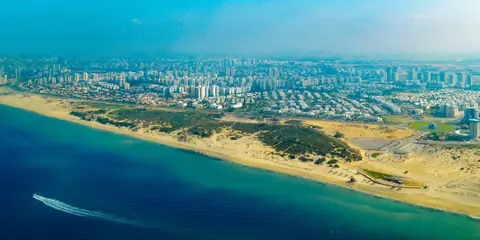
Sea, beaches & promenade
About 11 km of coastline, seven official bathing beaches that all fly the Blue Flag, and a seafront promenade being built along the city.
A city by the sea with thousands of years of history, still growing.
About 11 km of coastline, seven official bathing beaches that all fly the Blue Flag, and a seafront promenade being built along the city.
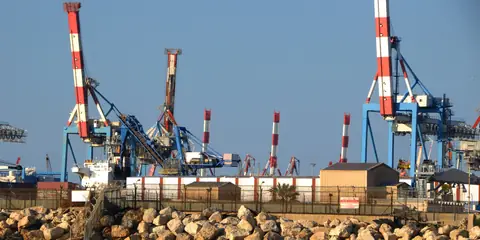
Ashdod Port is the country's largest by cargo ships and cargo volume, with the new South Port beside it: a real engine of jobs and economy.
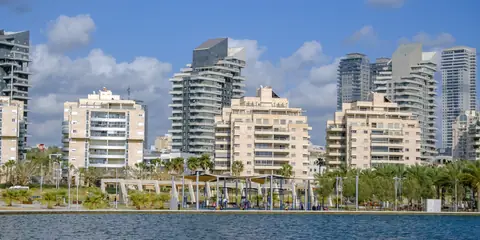
The 2017 umbrella agreement covers about 45,000 new homes, the new Park Lachish quarter broke ground in 2023, and the older quarters are seeing urban renewal.
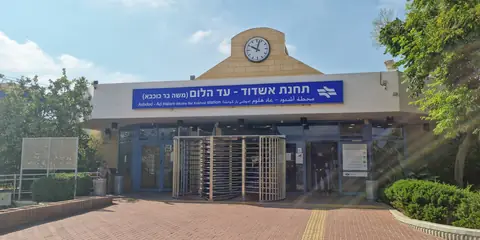
Ashdod–Ad Halom station on the Lod–Ashkelon railway, a new public-transport terminal since late 2022, and Route 4 links the city to Greater Tel Aviv and Ashkelon.
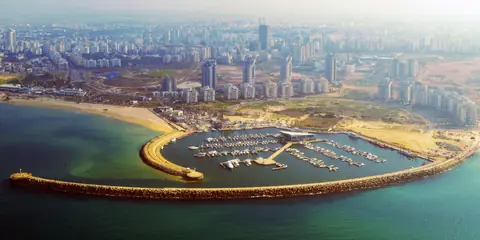
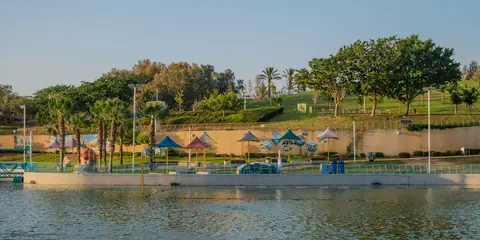
Ashdod-Yam Park with its lake and musical fountain, Lachish Park along the river, a central park in every quarter, and a marina with about 550 berths.
A planned city of quarters, each with its own shops, schools and parks. A diverse city that suits every community and every lifestyle, with people from all over the world.
Ashdod is one of the oldest cities in the Land of Israel; the area has been settled for about 3,700 years. In the 17th century BCE it is recorded as a fortified Canaanite city, and in biblical times it was one of the five Philistine cities and is mentioned in the Bible. The remains of the ancient city are in Tel Ashdod National Park, and on the coast stood Ashdod-Yam, a port town that by the 4th century had outgrown inland Ashdod. Today an ecological park stretches there, beside the Ashdod-Yam fortress.
Modern Ashdod was founded in 1956 on the sand hills by the sea. The first residents, 22 families of immigrants from Morocco, arrived in November 1956, and Ashdod became a city in 1968. It has since absorbed waves of immigration from around the world and grown to about 230,000 residents (Central Bureau of Statistics estimate for end of August 2026, as cited on Wikipedia).
Ashdod was planned from the start as a city of quarters (rova). Each residential quarter has its own shops, schools and public buildings, and its own central park. Alongside them are special quarters: the "City" business district, the Marina quarter, the Special Quarter and the new Park Lachish quarter.
The city stretches along about 11 km of coastline, about 6 km of it within the urban area. It has seven official bathing beaches and one surfing beach, and all seven beaches carry the Blue Flag. The seafront promenade began to be built in 2018 near Mei Ami beach.
Ashdod Marina opened in 1998 and has about 550 berths. The Marina quarter grew up around it, with a large square and an artificial lake completed in 2024.
Ashdod-Yam Park, the city's largest public park, opened in 2013, with lawns, an artificial lake with a musical fountain, sports courts, a skatepark and the Ashdod amphitheatre. Lachish Park runs along the Lachish river, and beside the Ashdod-Yam fortress there is an ecological park with walking trails and lookouts.
Ashdod Port is Israel's largest by number of cargo ships and volume of cargo handled, with the new South Port beside it. A high-tech park is being built near the southern entrance, by the train station and the hospital. Assuta Ashdod hospital opened in 2017; at the time it was the first public hospital built in Israel in more than 30 years.
In 2017 the city signed an umbrella agreement with the state covering about 45,000 new homes, about 30,000 of them under the "Mechir LaMishtaken" programme, plus transport infrastructure. The new Park Lachish quarter, east of the port, broke ground in 2023 and will include the city sports complex. The older quarters are seeing large-scale urban renewal (TAMA 38 and pinui-binui).
Ashdod lies west of Route 4, which links it to Greater Tel Aviv and Ashkelon, and the city has two fast entrances. Ashdod–Ad Halom station is on the Lod–Ashkelon railway, and a city and intercity public-transport terminal opened next to it in late 2022. The central bus station is at the City mall.
Ashdod is a city of communities: long-established communities alongside immigrants from all over the world, synagogues of every tradition, varied schools and community centres in every quarter. A city that suits every community and every lifestyle.
Whether it’s a family home or a smart investment, I’d be glad to guide you.
Information gathered from the sources above, correct as of the date read. Figures may change.